- New
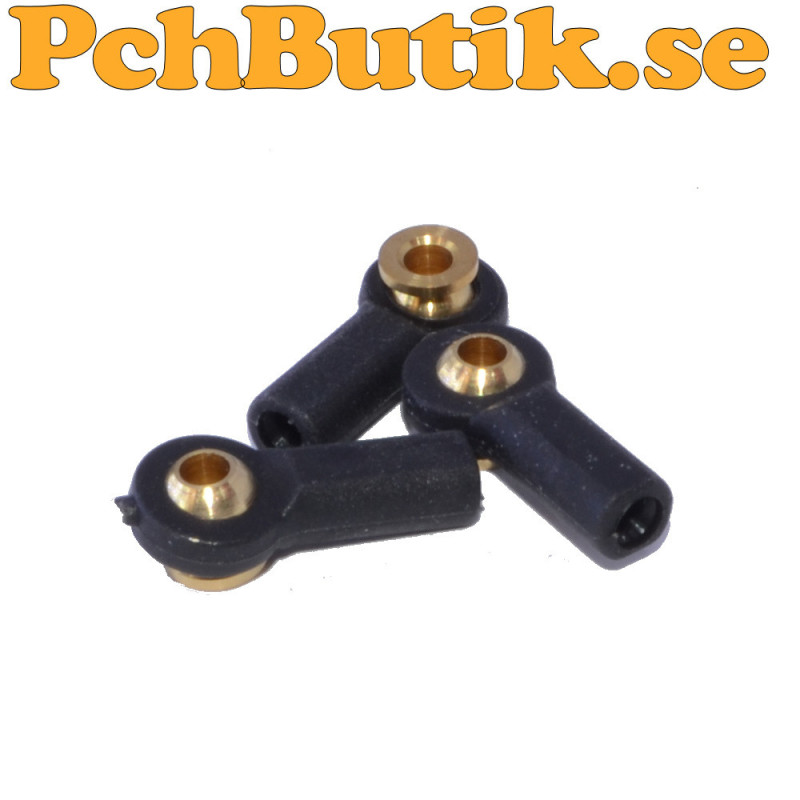


Lightweight ball link with 3 mm holes for mechanical linkages.
Article no: 2658
Information about this module is generated with the help of AI. The description may be incomplete, inaccurate, or subject to change.
The M3 Nylon Metal Ball Head Buckle Linkage Rod Tie is a compact ball link designed for mechanical linkages and moving mechanisms. The product consists of a brass colored metal part and a nylon component. The metal part is copper colored and non magnetic, which is consistent with a copper alloy such as brass.
The metal part has a through hole with a diameter of approximately 3 mm. The nylon component has a hole with a diameter of approximately 3 mm and a depth of approximately 10 mm. The holes are smooth and not threaded. The product is therefore intended to be used with a suitable rod, shaft, pin or other mechanical component.
The ball link allows angular movement between connected parts. It is suitable for mechanisms where the linkage needs to change angle during operation. The nylon component provides low weight and smooth movement, while the metal part provides a stable connection point.
The product can be used in RC cars, RC aircraft, RC boats, robots, servo linkages, steering mechanisms and other hobby projects requiring a flexible mechanical connection.
The overall length is approximately 20 mm. Please note that the holes are not M3 threaded.
Facts.
Product name: Nylon Metal Ball Head Buckle Linkage Rod Tie
Type: Ball link for mechanical linkages
Material: Nylon and copper colored metal
Metal: Non magnetic copper alloy, likely brass
Length: 20 mm
Hole diameter: Approximately 3 mm
Hole in metal part: Through hole
Hole in nylon: Approximately 10 mm deep
Thread: None
Application: Mechanical linkages and moving mechanisms
Example applications: RC models, robots and servo mechanisms
Included.
3 pcs
About the product.
Weight: approx 7 gram.
Contact us if you have questions at info@pchbutik.se
Article no: 2658
Remaining stock quantity can be found under the Product details tab.
In our range since: 2026-09-28
For you.
Components and building materials for those who build electronics themselves experiment and develop.
You might also like
Lightweight ball link with 3 mm holes for mechanical linkages.
Article no: 2658