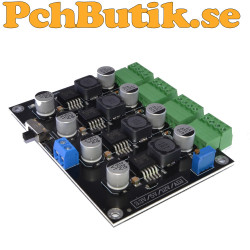
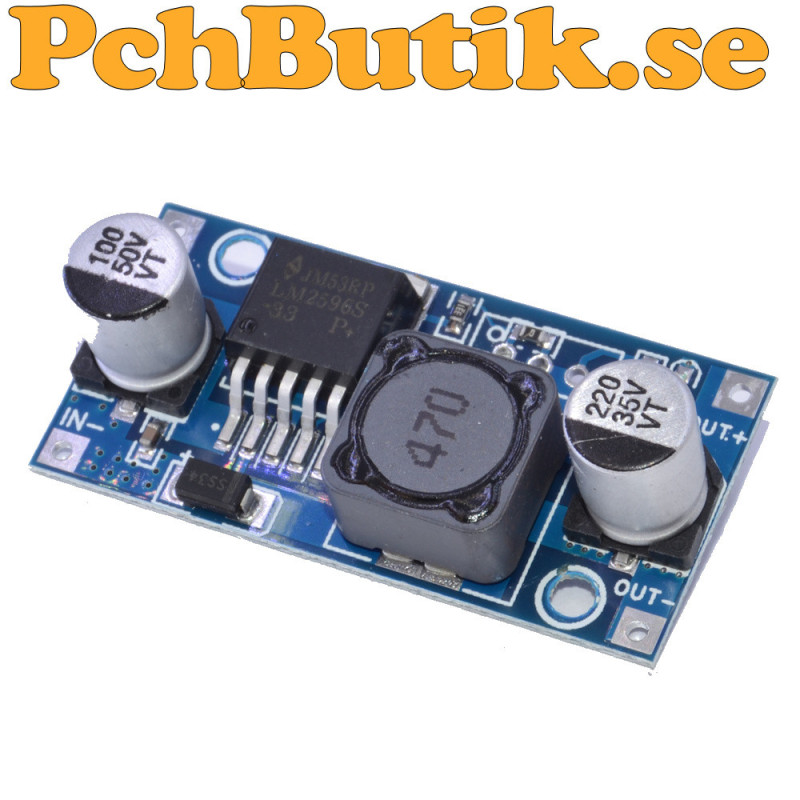



Efficient fixed 3.3 V DC-DC Step Down module.
Article no: 3629
Information about this module is generated with the help of AI. The description may be incomplete, inaccurate, or subject to change.
The LM2596 DC-DC Step Down module with fixed 3.3 V output is designed to convert a higher DC input voltage into a stable 3.3 V output with high efficiency. It is based on the well known LM2596 switching voltage regulator and is suitable for powering microcontrollers, sensors, communication modules and other electronic devices requiring a stable 3.3 V supply.
Unlike a linear voltage regulator, the LM2596 uses switching technology, resulting in significantly lower heat generation and higher efficiency. The conversion efficiency can reach up to 92 percent depending on input voltage, load and cooling.
The fixed 3.3 V version requires no output adjustment, making it simple to use in both prototypes and finished products.
See the attached experiment for instructions on how to disable the module.
The 150 kHz switching frequency allows the use of relatively small external components while maintaining a stable output voltage with low ripple.
The module is ideal for Arduino, ESP32, ESP8266, Raspberry Pi, development boards, industrial control systems and many other applications requiring a reliable 3.3 V power supply.
Facts.
Product type: DC-DC Step Down power supply module
Regulator: LM2596
Output voltage: Fixed 3.3 V DC
Input voltage: 4 V to 35 V DC
Maximum output current: 3 A
Efficiency: Up to 92 percent
Switching frequency: 150 kHz
Output ripple: Less than 30 mV
Operating temperature: -45 C to +85 C
Dimensions: 43 x 21 x 14 mm
Converter type: Buck Step Down
Applications: Arduino, ESP32, ESP8266, Raspberry Pi, sensors, control systems and other 3.3 V electronics
Included.
1 pc module.
About the product.
Weight: approx 13 gram.
Contact us if you have questions at info@pchbutik.se
Article no: 3629
Remaining stock quantity can be found under the Product details tab.
In our range since: 2026-08-03
For you.
Components and building materials for those who build electronics themselves experiment and develop.
Efficient fixed 3.3 V DC-DC Step Down module.
Article no: 3629