- New
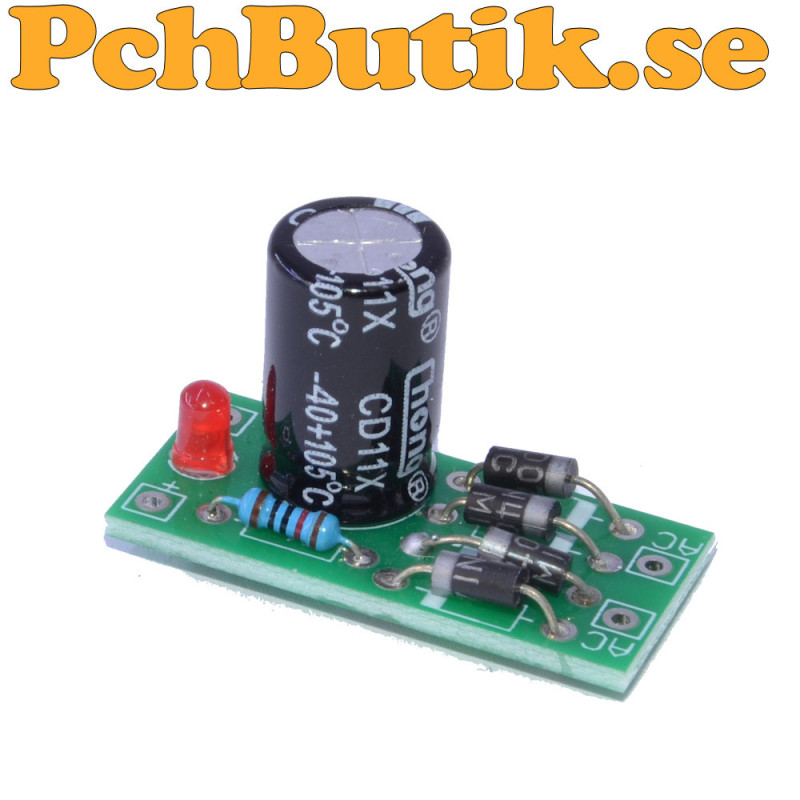



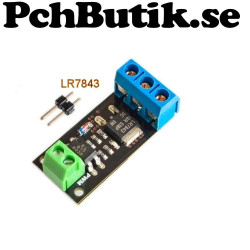
Compact rectifier bridge with smoothing and LED indication
Article no: 4013
Information about this module is generated with the help of AI. The description may be incomplete, inaccurate, or subject to change.
Rectifier bridge for AC voltage with four 1N4007 diodes, a 470 uF 50 V capacitor, a 10 kOhm series resistor and an LED with an approximate forward voltage of 2 V. The circuit converts AC voltage into DC voltage and uses the capacitor to smooth the rectified voltage.
The bridge rectifier is built with four 1N4007 diodes providing full wave rectification. After rectification, the 470 uF capacitor stores energy and reduces variations in the output voltage. The capacitor has a rated voltage of 50 V and is intended for the specified input voltage of 6 to 16 V AC.
The LED indicator is connected after the rectifier through a 10 kOhm resistor. The resistor limits the current through the LED and allows it to be used as a simple indication that rectified voltage is available. With an LED having an approximate forward voltage of 2 V, the LED current is relatively low, providing low power indication.
The product can be used in electronic circuits, control systems, experiments, hobby projects and other applications where simple AC to DC rectification with smoothing and voltage indication is required.
Facts.
Type: Rectifier bridge with smoothing capacitor and LED indicator
Rectifier diodes: 4 x 1N4007
Diode type: PN rectifier diode
Maximum average rectified current per 1N4007: 1 A
Input voltage AC: 6 to 16 V
Maximum input and output current: 1 A
Capacitor: 470 uF
Capacitor rated voltage: 50 V
LED forward voltage: approximately 2 V
LED resistor: 10 kOhm
Rectification: Full wave rectification
Application: AC to DC rectification and voltage indication
Included.
1 pc module.
About the product.
Weight: approx 8 gram.
Contact us if you have questions at info@pchbutik.se
Article no: 4013
Remaining stock quantity can be found under the Product details tab.
In our range since: 2026-09-21
For you.
Components and building materials for those who build electronics themselves experiment and develop.
Compact rectifier bridge with smoothing and LED indication
Article no: 4013