- New
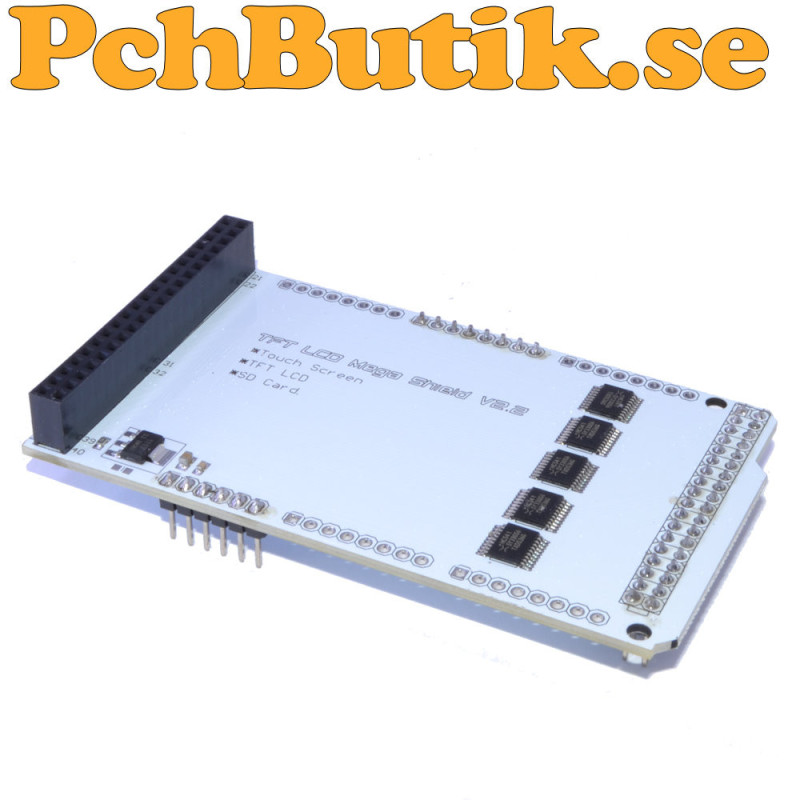


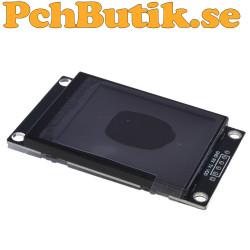
Adapter board for TFT01 LCD touchscreen with Arduino Mega
Article no: 3694
Information about this module is generated with the help of AI. The description may be incomplete, inaccurate, or subject to change.
The TFT01 is an adapter board designed to connect a TFT01 LCD touchscreen directly to a standard Arduino board. The TFT01 LCD operates at 3.3 V and cannot be connected directly to a standard Arduino board with 5 V logic without suitable voltage adaptation.
The adapter board simplifies the connection between the LCD screen and Arduino by providing a shield that can be mounted directly onto the Arduino board.
The board supports 16-bit data transfer to the LCD. When used with an Arduino Mega 2560, there are sufficient I/O pins to use both the touchscreen and SD card interfaces simultaneously, avoiding the limitations that may occur with smaller Arduino boards.
The updated white version uses IC-based voltage conversion instead of traditional resistive voltage dividers. This provides a more stable signal adaptation solution while maintaining the same functionality as the previous version.
This adapter board is designed for TFT01 LCD touchscreens supplied by EF Electronics. Use with other TFT displays is not recommended, as differences in voltage, current or signal adaptation may cause damage to the display.
Facts.
Product type: TFT LCD adapter board
Model: TFT01
Compatibility: TFT01 LCD touchscreen
LCD voltage: 3.3 V
Data transfer: 16-bit
Connection: Direct mounting on Arduino Mega 2560
Compatible Arduino boards: Arduino Mega 2560
Recommended microcontroller: Mega 2560
Touch and SD card: Can be used simultaneously with Mega2560
Voltage adaptation: IC-based
Design: White version
Application: Connecting TFT01 LCD touchscreen to Arduino
Included.
1 pc module.
About the product.
Weight: approx 30 gram.
Contact us if you have questions at info@pchbutik.se
Article no: 3694
Remaining stock quantity can be found under the Product details tab.
In our range since: 2026-11-23
For you.
Components and building materials for those who build electronics themselves experiment and develop.
You might also like
Adapter board for TFT01 LCD touchscreen with Arduino Mega
Article no: 3694